March 2023 Report

Interest Rate Volatility & Buyer Demand
Towards the end of 2022 and through January of 2023, we had seen average interest rates level off at a still high, but relatively more acceptable range between a high 5% and mid 6%. This relative decline from the summer highs, plus relative stability in rate fluctuations helped improve buyer demand as evidenced by a couple of modest spikes in mortgage (purchase) applications (you will need to scroll down to the purchase application chart on this link and possibly zoom in on the last few months to see these changes). This relationship, buyer demand rising as interest rates decline, obviously works the other way, and so we saw a slight decline in applications as rates spiked after the last Fed hike. But that is not the whole buyer demand story. That initial spike in mortgage applications still has some room to run because it can take a few months to find and close on a suitable home. So some of those potential buyers are still out there and they are driving us into Spring.
Some home builders are now offering to pay for rate buy downs, effectively bringing a buyer’s interest rate down to a more comfortable level. Same holds for sellers on the resale market. Knowledge of how interest rates work has not been a topic of serious consideration for most home buyers for a very long time. Now that higher rates are affecting affordability for more people, they are getting educated. People realize that the Fed is trying to push interest rates to help bring down inflation. In other words, it is a short term game. Equity and bond market players have also gotten comfortable with the notion that Fed hikes will likely react to key inflation metrics and they have priced these possibilities into their portfolios and investment strategies. This is all to say that rates are now fairly predictable because market actors are better at anticipating Fed policy. Predictability breeds confidence.
Keep in mind that Lake Las Vegas attracts more cash buyers than most markets in the area largely because of the higher price point and because it attracts vacation and second home buyers who tend to be more affluent folks. As you’ll see below, there is a bit of opportunism built into the decision on whether to take a loan or pay with cash that cash capable buyers may be willing to consider if the circumstances are right.
Lake Las Vegas by the Numbers
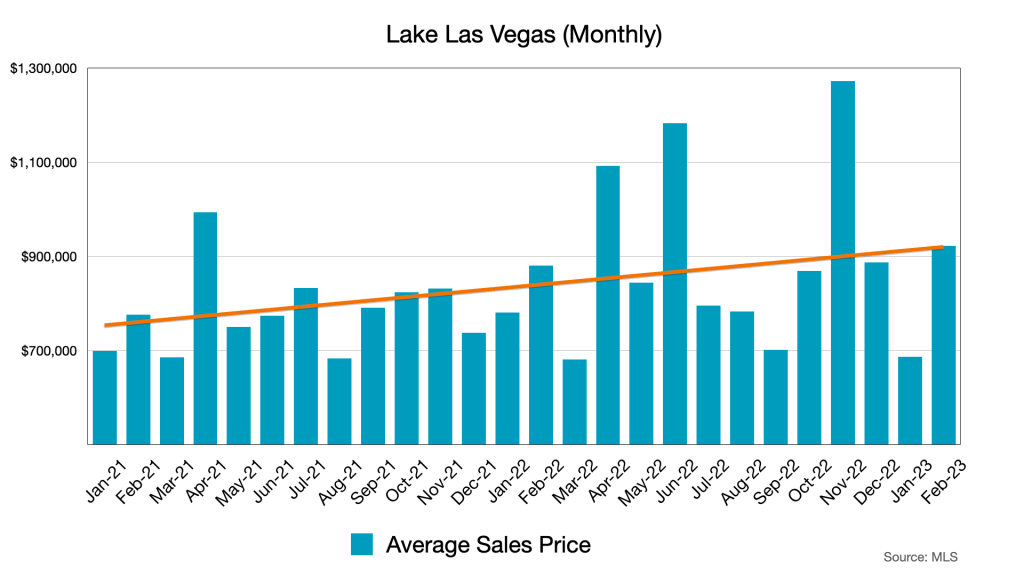
Lake Las Vegas had a good month for prices, but much of this improvement was driven by some high value sales in SouthShore. Click here to explore that sales data in more detail.
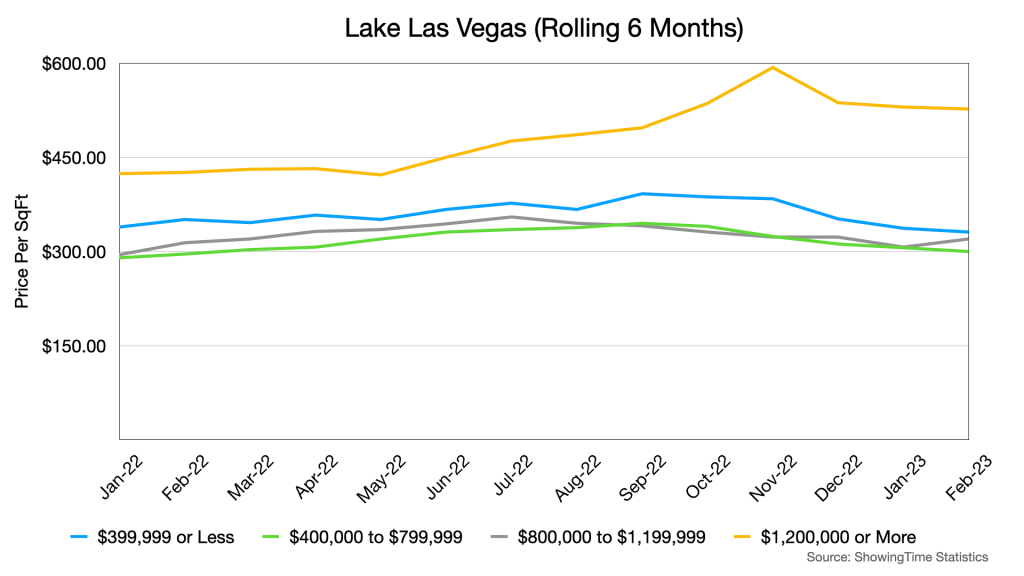
I’m generally reluctant to break down data from an already low number of sales into smaller segments, but I think it is important to understand that the Lake Las Vegas real estate market is not a homogenous market. I’ve broken the market into price bands. As you can see, the top price band, $1.2MM+ is outperforming all other price bands. The latest jump for this band at the end of 2022 has held more or less stable into 2023. The top two bands are both well above the maximum conforming loan limit of $726,200, which means one has to either take a Jumbo loan, make up the difference in the down payment, or pay cash to buy a home in these bands.
Pending sales stayed even, but new listings jumped once again in February. Anecdotally speaking, showing activity is on the rise. Buyers see some market opportunity as do sellers.

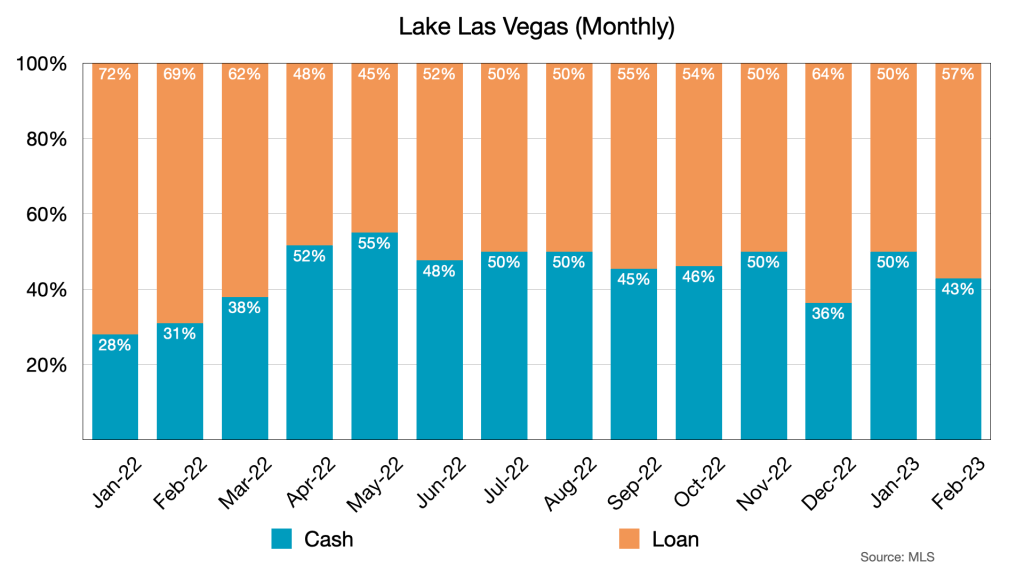
A slight dip in cash sales might suggest low interest rates drew more buyers towards traditional loans, but it is too early to tell. If buyers in the luxury $1.2MM+ band are in fact coming out to find opportunities to invest, then we may see support for this level of cash buying activity going into the spring and summer. Also, we are likely going to have interest rates closer to 7% going into spring add on slowly rising inventory and we may see some prices go down to attract opportunistic buyers (See below).
Please note that in the cash vs. loan chart above, I am including non-traditional financing such as private lending, owner will carry (OWC), wealth management based borrowing options and 1031 Exchanges to name just a few. We also cannot see exactly how much cash is being used in the “loan” purchases. Many high-net-worth buyers that are looking to buy homes in the upper two market bands may be paying well over the normal 20% for their down payment and they could also be paying points to reduce their interest rate. Cash is still a major factor for our market even if a traditional loan is involved.
Inventory is rising. It’s not quite a balanced market as there is heavy favoritism for the buyer’s side. More inventory means more choice and with that comes price competition and the ability for buyers to negotiate a better deal.
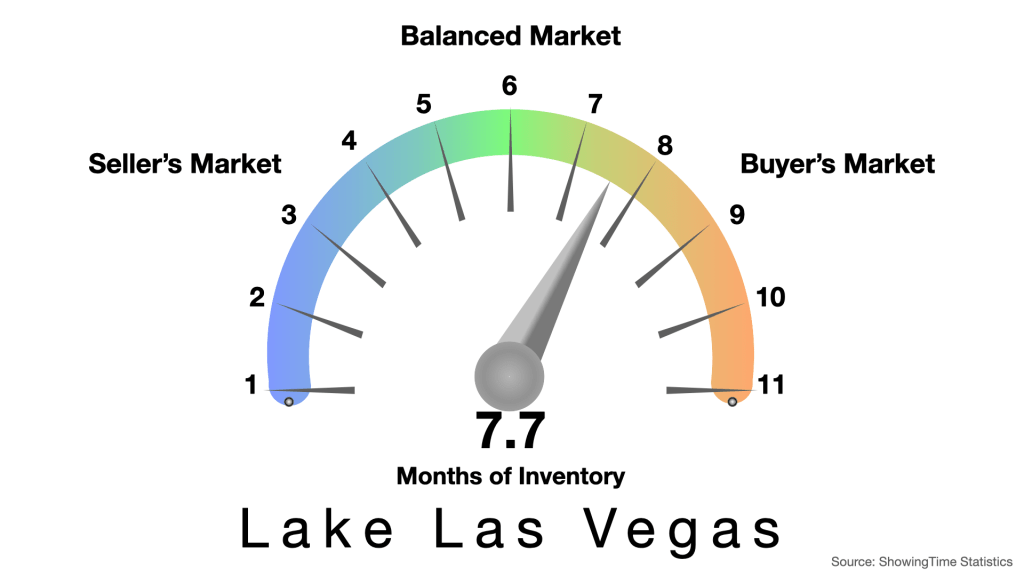
Let’s unpack what this all means for the near term. We are in a buyer’s market, but traditionally Lake Las Vegas has always had over 5 or 6 months of inventory. This is true across all market bands though traditionally, the $1.2MM+ band tends to take longer to sell due to the limited buyer pool. This is a long way to say that this is normal for this market. Lake Las Vegas homes tend to sell for about $100 more per square foot than the average for the entire Las Vegas market area, which is generally why our inventory takes a bit longer to sell. When you see that we are in a “Buyer’s Market” on the gauge chart above, you should not immediately assume that buyers are in command of the market, but neither are sellers. This is closer to a balanced market than you think. Most owners have plenty of equity and most of the outstanding mortgages these days, nationally and regionally carry much less risk than they did before 2008. So if you are a buyer waiting for distressed properties to hit the market at fire sale prices, I’m here to disappoint you. Yes, there may be a few opportunities here and there, but that is normal in any year. If there are homeowners who are struggling financially, they likely have plenty of home equity they can tap into to cover their immediate cash needs, so they have no reason to sell at fire sale prices. If you want a better way to imagine what the seller’s position is, understand that although prices have softened in recent months, they are still well above 2019 levels. It’s as if we were driving 120mph, saw a police car up ahead and slowed down to 105mph. You’re still getting pulled over and you’re still getting a ticket buster.
What Lake Las Vegas is seeing inventory wise is partly due to the fact that so few homes sold in the second half of 2022 that we have excess inventory plus new listings. New listings are to be expected in the spring. People who track interest rates, bond markets, mortgage backed securities and such are planning on more rate hikes. But because Lake Las Vegas attracts a lot of cash capable high-net-worth buyers those buyers don’t have to care too much about mortgage interest rates. Those buyers are also more likely to invest in residential real estate. In fact, according to the 2023 Knight Frank Wealth Report Pulse Survey of high-net-worth individuals globally, residential real estate ranks at the top of the list for investments that they consider “safest and least volatile,” which puts it above even gold as an investment. A home doesn’t need to be priced excessively low to be attractive to these types of buyers. Residential real estate investment is always a long term game. Prices are localized so homes in L.A. are more expensive than Las Vegas, which means buyers from more expensive markets usually have more ability to buy homes in our relatively lower priced market. Keep in mind that the Las Vegas/Henderson area is in the top 20 for international buyer traffic according to Realtor.com. We are also attracting nearly 30% of the potential Los Angeles, CA County based buyer pool. These buyers may be trying to escape recent “mansion tax” laws or perhaps are looking for a way to simply upsize without having to pay the L.A. premium.
The buyers are out there. Lake Las Vegas is an attractive location due to our unique features, resort amenities, and relatively balanced real estate market. In the short to medium term, prices are not going to grow at the same pace they were in 2021 and early 2022. In the long term however, they will continue to grow due to the nature of our buyer pool.
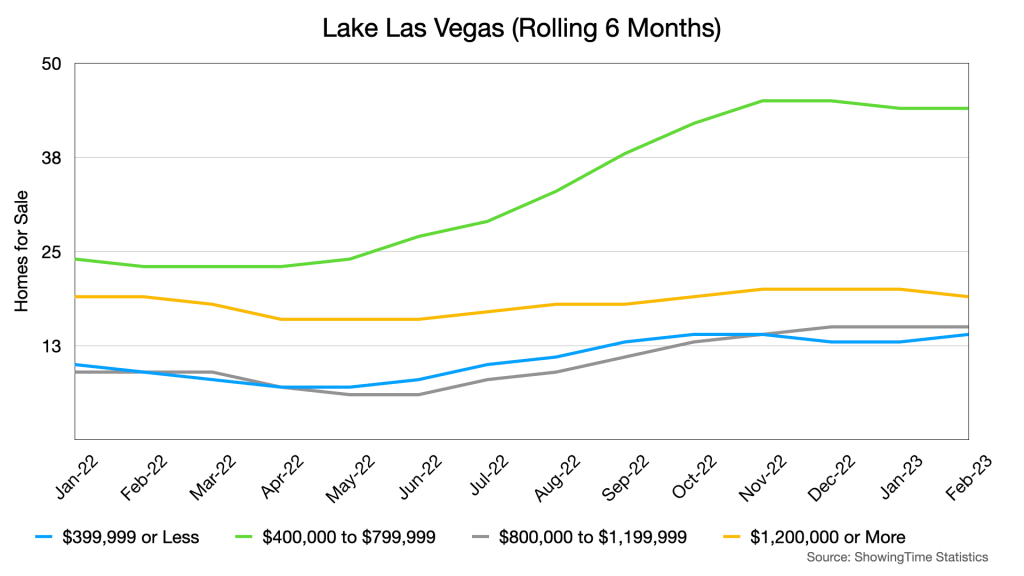
So we return to our banded breakdown. We have one category that is growing more than others in terms of inventory and that is the second band, $400k-$799k. It is worth digging a bit deeper, so I broke this band down into smaller bands below.
While each sub-band had some kind of increase in listings, by far, the biggest jump comes in the $500k-$599k band with a little jump for the $600k band as well. There is a reason for this. The green line represents the average price point for much of the builder listed inventory. Approximately half of the listings in the green band are builder inventory or condos. There are many reasons why a builder may want to build inventory homes, but often it is to simply turn inventory in a slower market or to have move-in-ready properties available to entice buyers who are reluctant to wait a long time during an uncertain economic cycle. Some inventory could be on the MLS because the deal fell through during construction. The inventory they list is selling, so I don’t think this says all that much about housing demand in general, but I’ve got my eye on it.

For more Lake Las Vegas real estate market data, click on the button below to access our dashboard.
Final Thoughts
Inventory is still outpacing buyer demand and has extended its lead. The latest interest rate spike has slowed the pace of mortgage (purchase) applications lately which might cool off some loan reliant buyer activity, but many of them are also learning how to navigate the interest rate situation a bit better. Incentives from sellers are making it easier for for buyers to buy down points. Cooperation is better for the market than pure adversarial competition as long as both parties respect each other’s need to get an optimal outcome. In this world, an optimal outcome is a closed deal that captures a reasonable net for the seller, which isn’t hard to get given how much appreciation there is still in this market, and the buyer needs to get the home they want for a price they are willing and able to afford. The more buyers study the landscape and talk to their real estate and mortgage professionals about options, the more they will become comfortable with making a creative choice. Buying a home at current rates leaves open the possibility of refinancing when rates inevitably go down at the end of the Fed’s quest to wrangle inflation. Buying cash offers a similar future refinance opportunity so that the buyer can reinvest that cash when other investment opportunities arise in the future.
Inventory is selling. Buyers are looking. Increased inventory doesn’t necessarily mean massive price reductions. Sellers are still getting around 95% of list price. Some seller’s may have overpriced their homes assuming low inventory would support their price and certainly there is room to negotiate or wait for the prices to drop, but most sellers are becoming realistic about the market and their agents have more and more comps to set a realistic price. Some of the inventory we are seeing is coming from builders and it competes with other resale so sellers that have comparable homes may need to be aware of that competition.
We invite you to leave your thoughts in the comments below.
Thank you,
Robin & Dave
Sign up for our monthly newsletter below.




 foresirealestate.com